

Nature is close to our hearts!
When Den Hunnegebier launched an appeal for its “loun eng Bei” (rent a bee) project in early 2022, we responded immediately. We thus became the first partner of this wonderful initiative, which the Guirsch family (beekeepers since 2018) launched in Luxembourg.
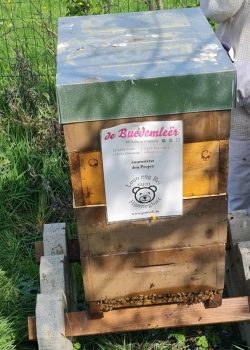
So we rented a hive and had it installed in the Guirsch family’s garden in Oberpallen.
We preferred to leave the hive on the land the Guirsch family has set up for this purpose, as it is more practical for them to look after it there. Hives need frequent visits to make sure the colony living in them is in good health, and the Zone Artisanale d’Ehlerange, where our company is based, is not the most suitable place for our friends the bees.
Nevertheless, the little island of greenery we have created around our workshop – with its plants, shrubs, quince tree and late-mown flowering lawn – adds a touch of green that benefits other bees as well as many other insects.
We harvest honey only twice a year.
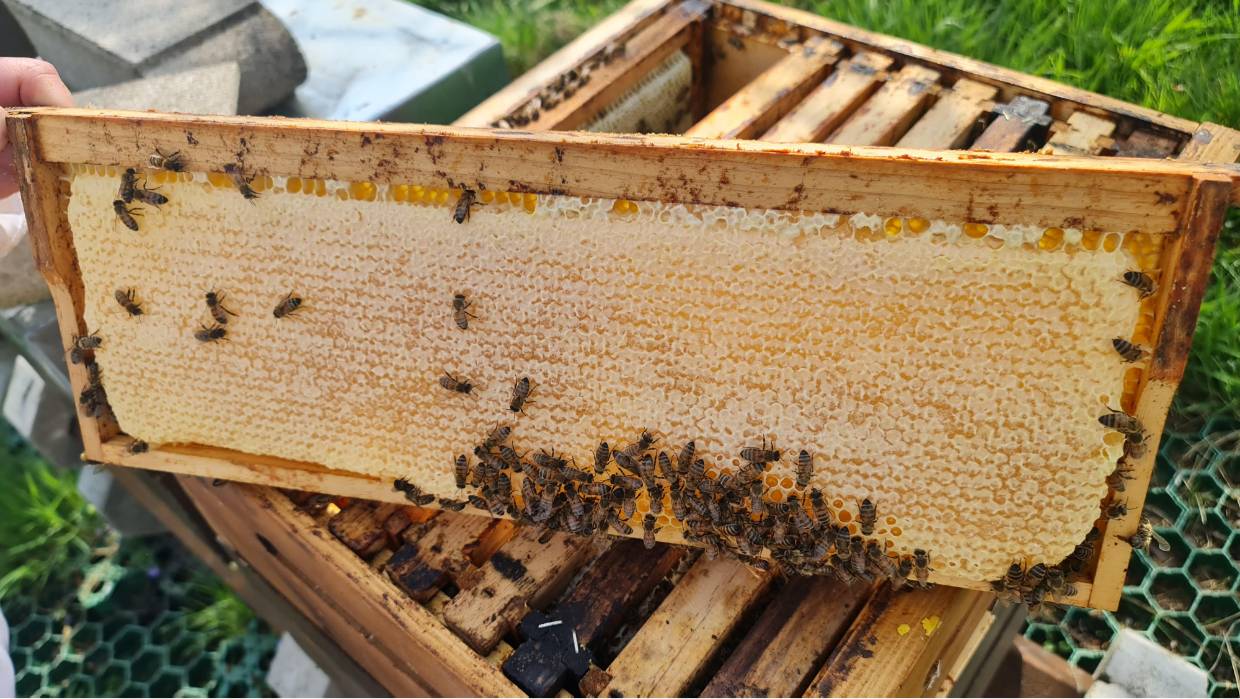
Out of respect for the hard work done by our dear hymenopterans, we harvest honey only twice a year – the first harvest, at the end of May 2022, yielded 13 kg. The second harvest is planned for the end of summer, i.e. early enough for the bees to rebuild their stores for the winter – and this second harvest will not take all the honey from the hive. The honey harvested will be given as a birthday present to our staff, as well as to our customers and partners (while stocks last).
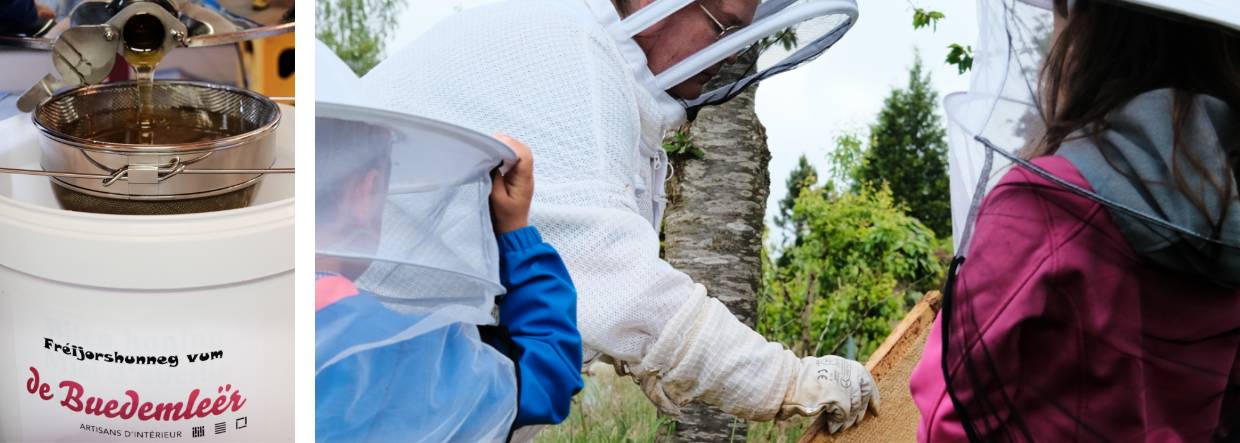
The youngest generation of de Buedemleër was able to watch the first harvest of 2022
Why did we make this choice?
We chose to rent a hive, of course, because nature is close to our hearts, but also so that – in our own modest way – we can raise awareness of the major role bees play in the ecosystem of the entire planet, and of the serious dangers caused, year after year, by their gradual disappearance.
To really grasp these risks, here are some figures from a study carried out by the CNRS (Conseil National de la Recherche Scientifique):
- around 35% of the world’s food production depends on pollination.
- 80% of plant species rely on pollination for their survival, reproduction and evolution, and bees play an essential role in the pollination process.
Interested in the Guirsch family’s initiative?
The Guirsch family have been beekeepers since 2018 and are the first in Luxembourg to offer private individuals the chance to rent a hive. What matters most to them is to:
- promote local beekeeping
- enable consumers to buy local honey and also to promote quality products.
- warn consumers about the dubious quality of cheap products.
If you are:
- a company
- a municipality
- a club, an association…
- a private individual
- a school, a childcare centre (maison relais)…
And you are interested in:
- supporting nature and bees
- seeing the beekeeper at work
- having your own honey
- supporting a local beekeeper
- highlighting your ecological responsibility
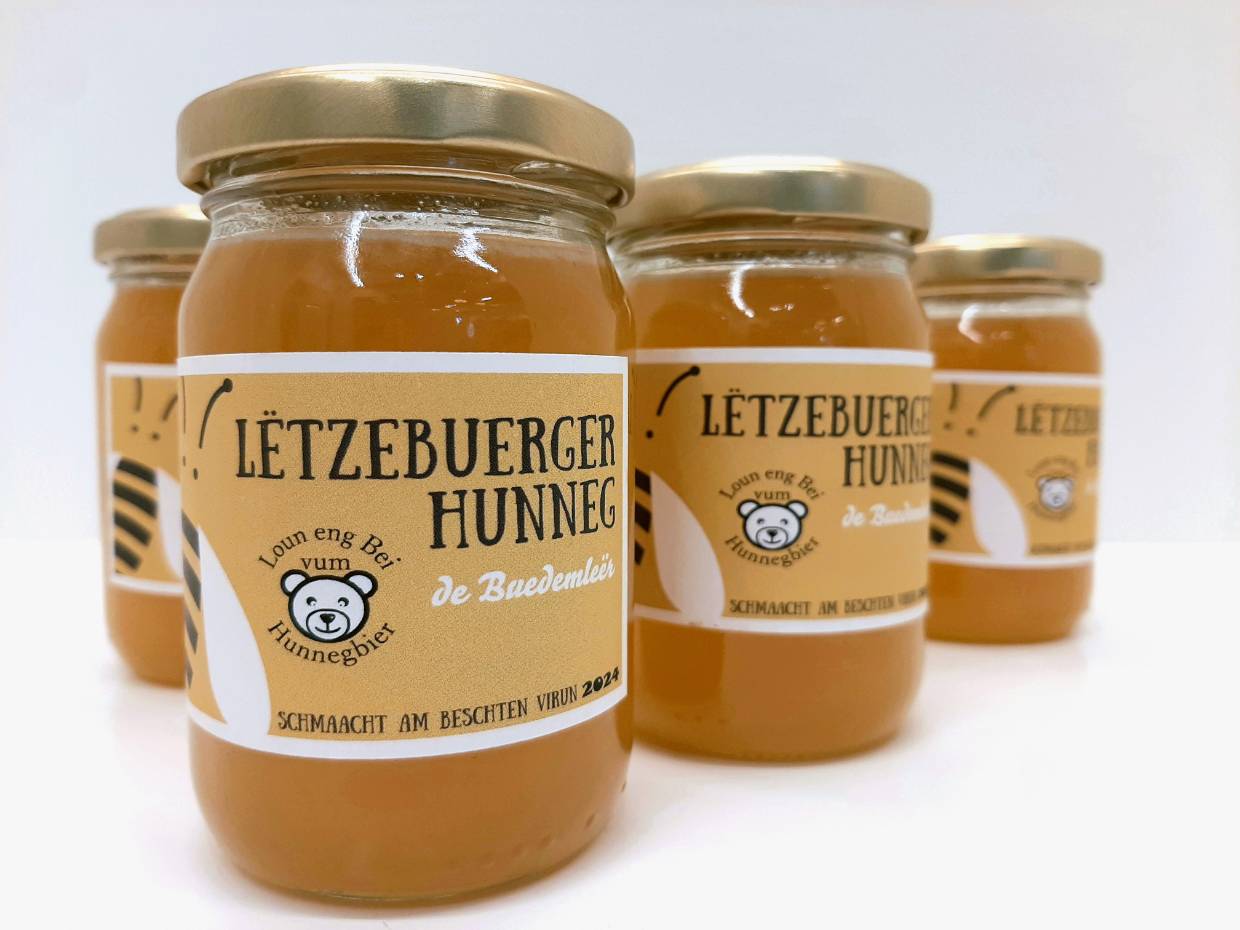
Then you can rent bees from the “loun eng Bei” project, and at the end of the year you will receive your honey. On request, you can even personalise the label on your honey jars, making for an original Christmas present.
To support a sustainable project and the bee population, simply contact Mr Guirsch via his Facebook page or via the website of Den Hunnegebier.
If you would like to install a hive in your garden, you should first know that a bee colony needs attention, care and know-how to ensure its well-being and survival. The website apis.lu will give you more information on the subject, and you can even sign up for free training courses.
According to Luxembourg beekeeping specialist Reichart Andreas, bees above all need “large areas” with plenty of flowers from which to collect their pollen. It is therefore important to renature the countryside and gardens with flower meadows rather than settling for lawns. These decisions lie with politicians; as citizens, you can share your concerns with them by taking part in petitions (national or international) or by getting involved with environmental protection associations such as Ouni Pestiziden.
The website of Sicona (Intermunicipal Syndicates of the Centre & South-West for Nature Conservation) offers anyone interested the chance to discover and carry out actions to renature the landscape; on their Facebook page you will also find videos for all audiences showcasing nature conservation actions.
Want to take practical action yourself? If you have a plot of land, you can do your bit with simple steps, for example: don’t over-concrete or over-gravel the garden in front of your house, favour flowering plants over hedges and non-flowering plants, and if you have the chance to plant one or more trees (fruit trees are even better), go for it – as well as providing coolness in summer, they produce far more blossom than ordinary flowering plants.
Did you know?
To produce 1 kilogram of honey, the 20,000 to 50,000 bees in a hive make 50,000 trips and visit up to 5,000,000 flowers, covering 40,000 km – the equivalent of once around the world at the equator.
1 kg of honey has the same energy value as 3 kilograms of beef or 50 eggs.
Bees born in autumn live for around 6 months, compared with 45 days for those born in spring.
The queen of the hive lays around 1,500 eggs a day in high season and 800,000 eggs over her lifetime.